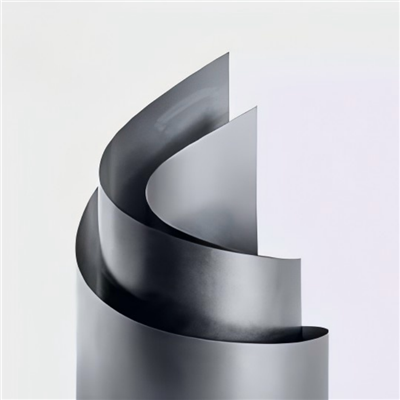
Hey there, folks! I'm a supplier of Flame - Retardant Graphite Film, and today I wanna talk about its magnetoresistance properties.
First off, let's understand what magnetoresistance is. Magnetoresistance is the change in the electrical resistance of a material when an external magnetic field is applied. It's a pretty cool phenomenon that has a lot of practical applications in things like sensors and data storage devices.
So, what about our Flame - Retardant Graphite Film? Well, graphite itself is a unique material. It consists of layers of carbon atoms arranged in a hexagonal lattice. These layers are held together by weak van der Waals forces, which allows for some interesting electrical and magnetic behaviors.
In the Flame - Retardant Graphite Film, the presence of the flame - retardant additives doesn't necessarily cancel out the basic electrical properties of graphite, but it can modify them to some extent. The magnetoresistance properties of this film are influenced by several factors.
One of the key factors is the structure of the graphite layers. In a well - ordered graphite film, electrons can move relatively freely within the layers. When a magnetic field is applied, these moving electrons experience a Lorentz force, which causes them to follow a curved path. This change in the electron path leads to an increase in the electrical resistance of the film, which is the basic principle of positive magnetoresistance.
However, the flame - retardant additives in the Flame - Retardant Graphite Film can disrupt the otherwise smooth flow of electrons. These additives might introduce scattering centers for the electrons. When electrons encounter these scattering centers, their motion becomes more chaotic. In some cases, this can lead to a decrease in the magnetoresistance effect compared to pure graphite film.
Another aspect to consider is the orientation of the graphite layers. If the graphite layers in the film are aligned in a certain direction, the magnetoresistance properties can be anisotropic. That means the change in resistance will be different depending on whether the magnetic field is applied parallel or perpendicular to the plane of the layers. For example, when the magnetic field is applied perpendicular to the graphite layers, the electrons have to cross the inter - layer region more often, which can result in a larger change in resistance compared to when the field is applied parallel to the layers.
Let's compare Flame - Retardant Graphite Film with some other types of graphite films in terms of magnetoresistance.
The Thermally Conductive Graphite Film is mainly designed for heat dissipation. Its structure is often optimized to maximize thermal conductivity, which usually means having well - ordered graphite layers. In terms of magnetoresistance, it might show a relatively strong positive magnetoresistance effect because of the free electron movement within the ordered layers. The heat - conducting properties don't directly affect the magnetoresistance but the high - quality graphite structure can contribute to a more pronounced magnetoresistance behavior.
The Multi - Layer Composite Graphite Film consists of multiple layers of graphite, which can be combined with other materials. The presence of these additional layers and materials can introduce more complexity to the magnetoresistance properties. The interfaces between different layers can act as scattering centers for electrons, and the overall magnetoresistance might be a combination of the magnetoresistance of each individual layer and the effects of the interfaces.
The Nanographite Film has a very small scale structure. At the nanoscale, quantum effects start to play a more significant role. The magnetoresistance in nanographite film can be quite different from that of bulk graphite films. Quantum confinement can limit the movement of electrons, and the magnetoresistance might show some non - linear behaviors depending on the size and shape of the nanographite particles.


The Heat - Dissipating Graphite Film shares some similarities with the thermally conductive graphite film. Both are focused on heat management. But the heat - dissipating film might have a different surface treatment or structure to enhance heat transfer. This can also have an impact on its magnetoresistance properties. For example, if there are surface coatings on the film, these coatings can interact with the magnetic field and the moving electrons, which might change the overall magnetoresistance behavior.
In practical applications, the magnetoresistance properties of Flame - Retardant Graphite Film can be quite useful. In some electronic devices, especially those that are exposed to magnetic fields, this film can be used as a sensor. For example, in automotive electronics, where there are often magnetic fields from various components, the film can be used to detect changes in the magnetic field based on the change in its electrical resistance.
Also, in data storage systems, the magnetoresistance effect can be exploited to read and write data. The Flame - Retardant Graphite Film's ability to have its resistance changed by a magnetic field can serve as a way to represent binary data (high resistance for one bit state and low resistance for the other).
If you're in the market for high - quality graphite films, including our Flame - Retardant Graphite Film, don't hesitate to reach out for a procurement discussion. Whether you need it for electronics, automotive, or other industries, we're here to offer you the best solutions.
References
- [1] Dresselhaus, M. S., & Dresselhaus, G. (1981). Electrical transport in carbon materials. Springer - Verlag.
- [2] Novoselov, K. S., Geim, A. K., Morozov, S. V., Jiang, D., Zhang, Y., Dubonos, S. V., ... & Firsov, A. A. (2004). Electric field effect in atomically thin carbon films. Science, 306(5696), 666 - 669.
- [3] Apsel, S. V., & Rao, A. M. (2001). Carbon nanotubes: Properties and applications. CRC Press.