


Hey there! As a supplier of graphite bipolar plates, I've seen firsthand how crucial heat dissipation is for these components. In this blog post, I'm gonna share some practical tips on how to improve the heat dissipation of graphite bipolar plates.
Why Heat Dissipation Matters
Before we dive into the solutions, let's quickly talk about why heat dissipation is such a big deal. Graphite bipolar plates are widely used in fuel cells and other energy - related applications. During operation, these plates generate heat due to the electrochemical reactions and electrical resistance. If the heat isn't dissipated effectively, it can lead to a bunch of problems.
For starters, high temperatures can reduce the efficiency of the fuel cell. The chemical reactions that produce electricity are temperature - sensitive, and excessive heat can throw off the balance, leading to lower power output. Moreover, overheating can cause thermal stress on the graphite bipolar plates, which may result in cracking or deformation. This not only shortens the lifespan of the plates but also poses a safety risk.
Understanding the Heat Dissipation Mechanisms
To improve heat dissipation, we first need to understand how heat is transferred in graphite bipolar plates. There are three main mechanisms of heat transfer: conduction, convection, and radiation.
Conduction is the transfer of heat through a solid material. In graphite bipolar plates, heat is conducted from the hot spots (where the electrochemical reactions occur) to the cooler parts of the plate. Graphite is a good conductor of heat, but its conductivity can be affected by factors like the purity of the graphite and the presence of impurities.
Convection involves the transfer of heat through the movement of a fluid (either a gas or a liquid). In fuel cell systems, a coolant (usually water or a water - glycol mixture) is often used to carry away the heat from the graphite bipolar plates. The coolant absorbs the heat and then transfers it to a heat exchanger, where it is dissipated to the surrounding environment.
Radiation is the transfer of heat in the form of electromagnetic waves. While radiation plays a relatively minor role in the heat dissipation of graphite bipolar plates compared to conduction and convection, it still contributes to the overall heat transfer process.
Tips to Improve Heat Dissipation
1. Optimize the Plate Design
The design of the graphite bipolar plate can have a significant impact on its heat dissipation performance. One way to improve heat conduction is to increase the surface area of the plate. This can be achieved by adding fins or channels to the plate. These structures not only increase the contact area between the plate and the coolant but also enhance the flow of the coolant, improving convective heat transfer.
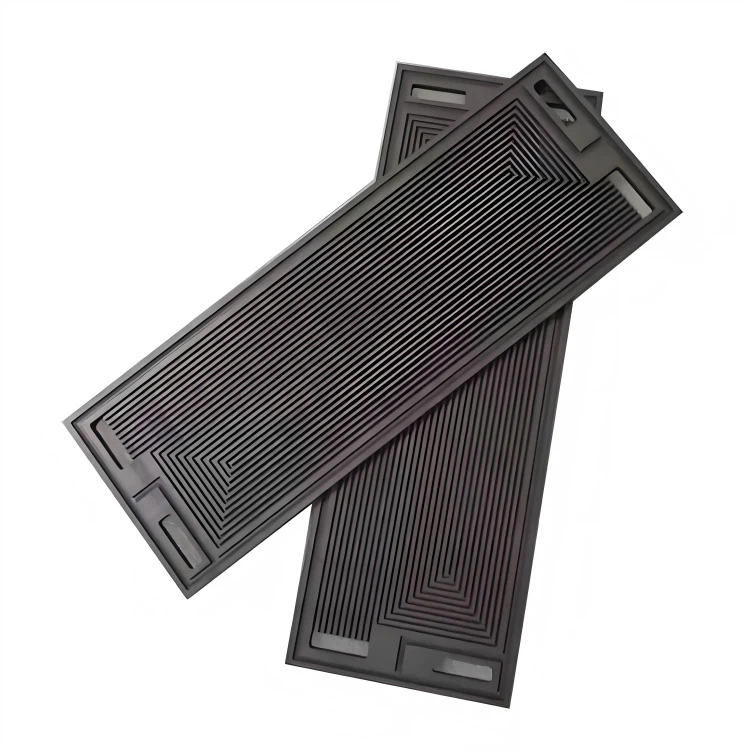
For example, a plate with a serpentine flow field design can promote better coolant distribution and more efficient heat removal. The serpentine channels force the coolant to flow in a more tortuous path, increasing the time it spends in contact with the plate and allowing for more effective heat transfer. You can check out our Conductive Graphite Bipolar Plate for some well - designed options.
2. Choose the Right Graphite Material
The quality of the graphite material used in the bipolar plate is crucial for heat dissipation. High - purity graphite has better thermal conductivity than graphite with a lot of impurities. When selecting graphite, look for materials with high density and low porosity. These properties ensure better heat conduction within the plate.
Our Energy Storage Electrode Plate is made from high - quality graphite materials that are carefully selected to provide excellent thermal conductivity and overall performance.

3. Enhance the Coolant System
The coolant system is a key component in the heat dissipation process. To improve its efficiency, you can increase the flow rate of the coolant. A higher flow rate means more coolant passes through the channels in the graphite bipolar plate per unit time, allowing for more heat to be carried away.
However, increasing the flow rate too much can lead to higher pressure drops in the system, which may require a more powerful pump. So, it's important to find a balance. You can also improve the heat transfer coefficient of the coolant by using additives or by increasing the temperature difference between the coolant and the plate.
4. Improve the Contact between the Plate and the Coolant
Good contact between the graphite bipolar plate and the coolant is essential for efficient heat transfer. Any air gaps or poor contact areas can act as thermal resistances, reducing the overall heat dissipation performance.
To ensure good contact, you can use a thermal interface material (TIM) between the plate and the coolant channels. A TIM fills in the microscopic gaps between the two surfaces, improving heat conduction. Additionally, proper installation and alignment of the graphite bipolar plates in the fuel cell stack are crucial to ensure uniform contact with the coolant.
5. Consider Composite Graphite Bipolar Plates
Composite graphite bipolar plates are another option to improve heat dissipation. These plates are made by combining graphite with other materials, such as polymers or ceramics. The addition of these materials can enhance the mechanical properties of the plate while also improving its heat dissipation performance.
For example, some composite graphite bipolar plates have a polymer matrix that can act as a heat - conducting medium, improving the overall heat transfer efficiency. Check out our Composite Graphite Bipolar Plate for more information on these innovative solutions.
Monitoring and Maintenance
Improving heat dissipation is not a one - time task. It's important to regularly monitor the temperature of the graphite bipolar plates during operation. You can use temperature sensors to measure the temperature at different points on the plate and in the coolant system.
If you notice any abnormal temperature increases, it could be a sign of a problem, such as a blockage in the coolant channels or a malfunctioning pump. Regular maintenance, including cleaning the coolant channels and checking the integrity of the TIM, is also essential to ensure the long - term performance of the heat dissipation system.
Conclusion
Improving the heat dissipation of graphite bipolar plates is crucial for the efficient and safe operation of fuel cell systems. By understanding the heat transfer mechanisms and implementing the tips mentioned above, you can significantly enhance the heat dissipation performance of your graphite bipolar plates.
If you're interested in purchasing high - quality graphite bipolar plates or need more advice on heat dissipation, feel free to reach out to us. We're here to help you find the best solutions for your specific needs. Let's work together to make your fuel cell systems more efficient and reliable!
References
- Incropera, F. P., & DeWitt, D. P. (2002). Fundamentals of Heat and Mass Transfer. John Wiley & Sons.
- Larminie, J., & Dicks, A. (2003). Fuel Cell Systems Explained. John Wiley & Sons.


